
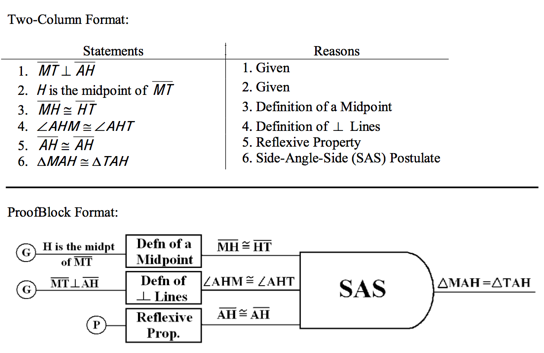
In the image above, we have a simple proof of
triangle congruence, written in the two-column and ProofBlock
formats. In comparing the two, notice how each of the statements in
the two-column proof has become a connection between ProofBlocks.
The rules governing the logical order of statements in traditional
proofs are still evident in this format, with statements required
to form a given conclusion being written before (to the left of)
their conclusion.
ProofBlocks helps students retain the requirements and conclusions associated with each theorem, definition, or postulate without the struggle of repeatedly wading through mathematical jargon. At the same time, the idea that proofs consist of a logical chain of reasoning supported by previous statements is firmly established in their minds.
Once this has been achieved, the conversion from ProofBlocks to two-column and paragraph proofs is no longer difficult. The lengthier and more algebraic the proofs, the more dissatisfied students become with having to work sideways across a page. In fact, many students enjoy transitioning to the more concise two-column format because they are already comfortable with strategies for deductive reasoning they learned using ProofBlocks.
The process of conversion to two-column proof is supported when students number statements from left to right, recognizing that the “reason” for each statement lies in the block that precedes it. In fact, even when moving their work into formats where connections are no longer visible, we have found that students still seem aware of the importance of theorems in justifying conclusions and what it means to logically order a proof.
ProofBlocks helps students retain the requirements and conclusions associated with each theorem, definition, or postulate without the struggle of repeatedly wading through mathematical jargon. At the same time, the idea that proofs consist of a logical chain of reasoning supported by previous statements is firmly established in their minds.
Once this has been achieved, the conversion from ProofBlocks to two-column and paragraph proofs is no longer difficult. The lengthier and more algebraic the proofs, the more dissatisfied students become with having to work sideways across a page. In fact, many students enjoy transitioning to the more concise two-column format because they are already comfortable with strategies for deductive reasoning they learned using ProofBlocks.
The process of conversion to two-column proof is supported when students number statements from left to right, recognizing that the “reason” for each statement lies in the block that precedes it. In fact, even when moving their work into formats where connections are no longer visible, we have found that students still seem aware of the importance of theorems in justifying conclusions and what it means to logically order a proof.
Format Comparison