
First, students will look at the picture, the
givens, and the prove statement. The possibility of using the
knowledge that “corresponding parts of congruent triangles are
congruent” (CPCTC) to find the final pair of congruent angles may
or may not occur to them at this time. However, they will almost
certainly suspect that the two triangles are congruent. In the
toolkit of blocks before them, there are only four that have
congruent triangles as an output. They separate those from the rest
and then look at the given information: two pairs of congruent
sides and a pair of congruent angles. These givens are appropriate
inputs for only one of those four blocks: SAS Postulate.
Since the givens satisfy the three required inputs to SAS, students can see that they have completed the first part of the proof, and can now focus their attention on the second piece. The SAS Postulate proves that triangles are congruent, so they must now find a block in their toolkit that takes congruent triangles as an input. CPCTC fits that description and returns congruent segments or angles, the latter being the aim of the proof. Our students can now draw their proof as shown, certain that their logic is correct because all of the inputs and outputs of the blocks match. They know that they have reached the end because the final outgoing piece of information matches the prove statement in the original problem.
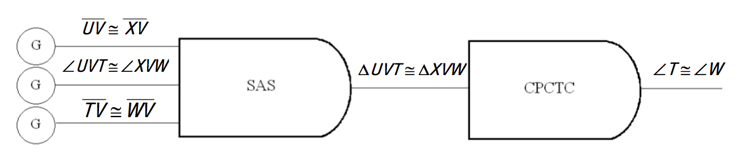
Since the givens satisfy the three required inputs to SAS, students can see that they have completed the first part of the proof, and can now focus their attention on the second piece. The SAS Postulate proves that triangles are congruent, so they must now find a block in their toolkit that takes congruent triangles as an input. CPCTC fits that description and returns congruent segments or angles, the latter being the aim of the proof. Our students can now draw their proof as shown, certain that their logic is correct because all of the inputs and outputs of the blocks match. They know that they have reached the end because the final outgoing piece of information matches the prove statement in the original problem.
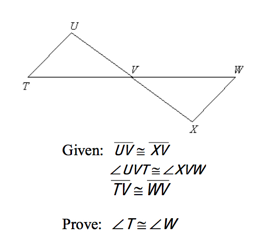
Consider how students might complete the very
basic proof of congruent angles shown to the left. ProofBlocks
allows students to start working in the middle of the proof instead
of having to begin with only the givens.
Example Proof